Wednesday, August 13, 2014

Pokhara: CBID Goes West


After delaying our trip to Pokhara by a day, we went to the airport once more on Wednesday morning hoping that the rain would stop long enough for the Pokhara airport to open. Only a few more hours of waiting later, the airport opened up and we were on our way!

A short flight and a drive later, we made it to our scenic hotel in Lakeside, one of the neighborhoods in Pokhara. Once we had dropped off our things (we stayed in the penthouse rooms, with an amazing balcony and a view to go along with it), we sat down for lunch downstairs for some delicious momos, curry, and fried rice. Our first meal in Pokhara set the bar high, as Aaron said his veg. curry was one of the best curry dishes he has ever had--needless to say we were excited for what the rest of the area had to offer.
Hotel Lake Star, Lakeside, Pokhara

Once we had finished lunch, we piled into the hotel car and went over to the Gandaki Medical College Teaching Hospital, a fairly large private hospital that cares for patients in the Gandaki zone (one of 5 current "zones" in Nepal, where zones contain many districts, of which there are 75). Here, our teams split up and the MIS team (Aakash, Patience, and I) put on our scrubs and went in to see Dr. Bhoz do a laparoscopic cholecystectomy. It was harder to believe the similarities than the differences between GMC and JHH (Hopkins), given limited resources, but they managed just fine. With one set of laparoscopic instruments, including a Stryker camera, which was recently purchased by the surgeon, not many procedures could be done in one day when sterilization, turnover, and maintenance of the instruments and other resources were taken into account. The day we went, he was scheduled to do 4 lap choles, but had to move 2 of them to the next day due to insufficient drapes and surgical gowns, in part due to the rains that kept the surgical cloth wet on the railings where they are normally set to dry. Additionally, with a room a third the size of the average OR at JHH and no fan or system for circulation of air, the room was quite hot and stagnant. Despite all this, and the fact that his instrument set only really had the basics, he finished the procedure in just under an hour (one of his longer times). It was a privilege to work with one of the initial pioneers of laparoscopy in the Kathmandu valley, and he gave us very helpful feedback about all four major areas for consideration regarding minimally invasive surgery: 
- Training
- Instrumentation/Technology
- Sterilization/Maintenance
- Safety
Gandaki Medical College Entrance Desk


Team preterm had a positive experience as well--there was a promotion where Gandaki was giving patients free surgeries (including delivery!) for the whole month and patients only had to pay for medications. One of the largest issues was a social one. Mothers would come in asking for a 100% guarantee that the delivery of their child would go off without a hitch, but providers are hesitant to make this promise, since it just isn't feasible--complications cannot always be predicted.

In addition, Aaron and Allie discovered that people tend not to adopt KMC because they think of it as a low-tech solution, and overlook it in favor of flashy, high-tech solutions that seem more effective (but in reality, are usually not--simple design is key!) like incubators, or in the case of breast feeding, formula feeding.

After seeing a case at the hospital, Dr. Bhoz was done for the day, and we headed to Fewa Lake, just below the Annapurna mountain range. On the way, we had our afternoon chai at a local restaurant, and then drove over to the lakefront. We took a catamaran out to a small island temple with Dr. Kusum and Sheetal, and took in the amazing view as the sun went down.
The view of the mountains from the catamaran on Fewa Lake

Dr. Kusum: The best guide (BG)

To end what had been our best day yet in Nepal, we had local Nepali Thali, a special all-you-can-eat meal consisting of rice, potatos, dal, curd, mutton (in this case), saag (greens), and bitter root. Aakash, Aaron, and I enjoyed this the most, eating with our hands, as is traditional, and only looking up when more rice, dal, or mutton was brought out. After day 1 in Pokhara, we had decided it was our new favorite part of Nepal--after all, it is a well-kept secret, and we haven't even seen it all yet.

Eating local cuisine, Nepali thali, in Pokhara

Tuesday, August 12, 2014

Are we in Pokhara yet?

Today was by far one of the most interesting days we've had in Kathmandu. We woke up at 8am, had breakfast at the hotel and headed to the Jhpiego office to get some group work done before leaving for Pokhara. At 11am, we wondered through the streets of Patan until we found a nice Indian fast food restaurant named after the Annapurna mountains. The Annapurna restaurant (which I highly recommend) served the cheapest and tastiest food we have had so far, and I'm pretty sure that Ian would recommend the delicious chili momo's which he kept raving about.
My aloo paratha at the Annapurna restaurant. Only 95 cents of deliciousness!

At 1.30pm we hopped into two taxis and headed over to the local airport, where we boarded our Buddha airways flight to Pokhara.
Displaying 20140813_084217.jpg Dr. Kusum entertaining the team as we waited for our flight at the airport 

About 20 minutes into the 25 minute flight, our pilot announced that the plane would be returning to Kathmandu due to heavy rains in Pokhara.  Pokhara which is second city of Nepal has a population of over 300,000 inhabitants and is located approximately 200 km west of Kathmandu. Three out of the ten highest mountains in the world; Dhaulagiri, Annapurna and Manaslu are within 30 miles of the city, therefore during the monsoon season, there is very poor visibility for airplanes to land.
Displaying 20140813_113350.jpg
View of Pokhara from the plane


Once we got back to Kathmandu, we waited at the airport until 6pm, however the rains never cleared out in Pokhara, so we were forced to go back to our guest house.
Displaying 20140812_171824.jpg
Yes, there are monkeys (and pigeons) in the Kathmandu local airport!

On the other hand, Aaron made new friends with a group of Chinese women on the flight who spoke very little English; they ended up spending the night at Kathmandu guest, in hopes that they will be able to catch the next flight to Pokhara for their vacation.

Our night ended with a peaceful candlelight dinner at the Rum Doodle restaurant in Kathmandu; the place where everyone who conquers Mt. Everest is welcome to eat for free for the rest of their lives!

Although the day didn't turn out the way we planned, we got to experience some of the challenges people in Nepal have to deal with, and therefore learned to appreciate the flexibility that the Jpiego staff must have to plan programming and change plans quickly if need be.


Based on our experiences thus far, here are a few things we need to consider when designing for a country like Nepal:
  • Electricity supply, or rather the lack of it
    • What is the source of power, and what means do people resort to during power cuts?
  • The weather
    • How would a sick patient be transported for an emergency procedure during bad weather?
  • Cultural barriers
    • What are the social norms, and how can we design something that will not pose a cultural threat?
    • How willing are people to adapt to changing circumstances?

Monday, August 11, 2014

Happy Hospital Day + Books Come Alive

On Monday, we had our first clinical experience, visiting Kathmandu Medical College (KMC).  We started off the day at Jhpiego headquarters, reviewing the relevant aspects of labor and delivery and planning out the logistics for our trip to Pokhara later during the week. 

The team planning out the week at Jhpiego Nepal
We then took a 20 minute cab adventure to KMC.  I say cab adventure because between the bumpy roads, oncoming traffic in your imaginary lane, and last second dodging of motorcycles, there really is no such thing as a normal cab ride in Kathmandu. We arrived in one piece and entered into KMC.

Upon entering, we were quickly honked out of the way.  Turns out, the entrance to the hospital is open to cars as well, 'drive through' style.  Most people were able to duck out of the way, but one of our coordinators, Sheetal, saw some hand to metal action as the car brushed by her. Fortunately, she was ok.
 The mix use lane
We met with a variety of hospital administrators and staff, with our host, Dr. Kusum Thapa, leading the way.  After a warm welcome with plenty of customary milk-chai tea to go around, we met briefly with Dr. Govind Sharma.  Dr. Sharma formerly held the post of vice chancellor of health, with the chancellor being the former king before the absolution of the Nepalese monarchy.  We found out that there are a total of only 12 biomedical engineering students in Nepal right now who usually  work for pharmaceutical and device companies after graduation, not unlike the path that some of us may take after CBID.  Further visits with Dr. Karki, principal of KMC, and Dr. Saha, head of OB/GYN, to clarify our purpose and discuss potential project areas gave birth to some cutting edge ideas for both our pre-term and minimally invasive surgery (MIS) focuses.

Team meeting with Dr. Karki and Dr. Saha

One thing you notice in Nepal is the intermitten power cuts throughout the day which range from 18 to 22 hours at a time.  Even though the hospital has backup generators which power the hospital through these daily cuts, the current infrastructural reality dictates that devices must be innovative energy sippers.  As Allie and I visited the NICU area and Kangaroo Mother Care wards of KMC, we saw one device that epitomized the resourceful nature of the hospital in the face of these unique sets of challenges: a locally designed baby incubator.  To provide heat, two halogen lightbulbs below the baby bed were utilized in conjunction with a control system which turned on the lights whenever the temperature dropped to 36 C.  To provide humidity, a pan of water could be placed in the same subspace.  Furthermore, a backup battery was constantly being charged during use in case the hospital backup generators did not produce enough power.  The device was also modular in the sense that virtually any phototherapy light could be incorporated with its clear top lid.  The models in use have lasted 15 years at KMC, a testament to the foresight of its original designers.

Locally made, locally sustained

 After consolidating our meetings and regrouping with the MIS team, we took another cab adventure back to our place of stay, the iconic Kathmandu Guest House, which some credit with being the catalyst for the growth of the surrounding tourist region of Thamel.  Historical or not, we had some more immediate issues to attend to.  I had always wondered why COPD and other respiratory complications were becoming heavyweights in global disease burden projections. Holding my breath through the dusty and smoky streets of Kathmandu put to rest any questions I had.  We picked up some 40 rupee facemasks from the local supermarket and were pleasantly surprised that Nike and Adidas had decided to enter the low cost cotton facemask market.     

"Fakemasks from Afar" at KGH. Ian, Aakash, Patience, Aaron

After dinner at another great momo restaurant, we settled in for the night.  It was the perfect opportunity to finish a book I started on this trip, Second SunsDavid Relin's posthumously published book explores the life of how Dr. Sanduk Ruit, a local Nepalese ophthalmologist, has revolutionized the world of cataract surgery through innovative surgical techniques that drastically reduce procedure time while providing results as good as the leading cataract surgeons in the developed world. I've shadowed cataract surgeries in the middle of the Amazon and in the states and to think that the same 30-40 minute procedures could be done in 5 minutes in a school-converted-to-operating-theater-in-the-middle-of-the-Himalayas definitely took me by surprise. Add in the fact that Ruit's partner in conquering blindness around the world is an ophthalmologist who invented bungee jumping, scaled Everest, and plays top tennis players around the world between performing up to 80 cataract surgeries in one sitting, and you have a story filled with two modern day visionaries.


I can't think of a better book to be lent for this trip (thanks Allie!), as many of the landmarks described are in areas where we have frequented.  Tilganga, the eye hospital mentioned, was right next to the Tribhuvan airport where we arrived.  Ruit's residence is right next to Swayambhuthath, the monkey temple we had visited days before.  Things became too surreal when the lobby of the KGH was described and all I had to do was look around the couch I was nestled in to see where Ruit had conversed with Relin.  Strange coincidences aside, I would still have to say that this was one of the most inspiring stories I've ever read.  My short review here does not do it justice, and for anyone coming to Nepal or interested in eye care, it's a must read.         

Sunday, August 10, 2014

Bhaktapur and Hospitals

After the usual continental hotel breakfast, we took a taxi to Bhaktapur, an ancient city filled with beautiful architecture and intricate pottery. It was the capitol of Nepal during the 15th century and is now a cultural gem. We were impressed as soon as we arrived. The entire city was constructed with wood, brick, and metal. Unlike the bright streamers and colorful store fronts which popped eclectically throughout Thamel, Bhaktapur had a more tame color palette. The roads were paved and swept, the drivers were calmer, and there were no intriguing advertisements for canned noodles and "rockingly strong" beer. Where Thamel was a living and chaotic city, Bhaktapur was ancient and subdued. We greatly enjoyed the change of pace. We climbed up one of the many, tall, well maintained temples in Durbar Square, giving us a great view of the mountains.Displaying 20140810_131027.jpg
And gave Patience a great view of the the rest of us.Displaying 20140810_032433.jpg
While we were making our rounds through the temples, many people asked us why were there. We told them we were engineers and were then given a lengthy historical lesson on the origin of the temples. Everyone there swelled with pride when speaking about their city.  Even to this day, the temples are well-maintained by the natives who live there.  I saw a shining example when one woman was slicing off the moss from the steps of one of the buildings. Her only tool was a small carving knife and there seemed to be an endless amount of moss. It was a job that would take days to complete. I was astounded by the painstaking effort of the people to keep the ancient city alive. After sight seeing we ate lunch on a rooftop restaurant.
Displaying 20140810_041213.jpg
We took our biggest risk of the trip when we ordered a mixed fruit lassi which contains fresh fruit, milk, and yogurt. Thankfully, nothing has happened. As we left the restaurant, a group of young boys with painted faces, gathered around Patience. They were mesmerized by her hair. One child asked her if he could touch it. Patience agreed and all the children gently stroked her braids. After this formality the children told us that they were getting ready for the festival tomorrow, which would involve a lot of stick dancing, music, and food. We started work tomorrow and could not see the festival.
We left Durbar Square as other children started noticing Patience's hair and tried surrounding us once more.  We quickly got lost in the streets. Serendipitously, we came across the Human Organ Transplant Center. Though our work was to start the next day, we decided to check out this medical facility. After telling a hospital worker that we were engineers, he showed us their current and well-maintained dialysis room which had eight beds. He also told us that 20 kidney transplants had been done there in the two years the facility was open. The Bir hospital in Kathmundu is a more well established transplant location and has done 108 transplants. The worker told us that there is no facility for liver, pancreas, bone marrow, heart or lung transplantation in the country. Our first look at the healthcare system was very conflicting and surprising. Though the facilities were clean and the the dialysis machines were current, many life-saving transplants were not being done. It reminded me of that woman who was cutting away the moss in Bhaktapur. These were dedicated people who got used to the lack of resources. They were overwhelmed with jobs that they were not equipped for and did what they could to keep everything afloat. There was nothing innovative. We left the hospital and took taxis back to the hotel. We were ready to get to work.
http://hotc.org.np/

The Streets of Kathmandu

The moment you step into the streets of Kathmandu, the sights, sounds, and smells overwhelm your senses. The air is thick with dust and humidity, and it's not surprising to find that this city is one of the most polluted in the world. Depending on the wind, you may catch the scent of incense or tea, or sweat and garbage. That variability fits in with a city that is both vibrant and full of life, yet desperate and frenzied at the same time.


Navigating the streets here is an elaborate game that requires heightened senses. There is plenty to watch out for. Avoid the taxis, motorcycles, and bicycle rickshaws that compete for space on the narrow roads. Ignore the promises of the salesmen and the pleas of the beggars, no matter how badly you want to try to lift these people out of poverty. Be aware of the skinny, flea-bitten dogs and their waste left on the side of the road. At the same time, do not neglect the life and joy around you. See the bright colors that fill the pashmina shops and decorate the tiny houses. Notice the children happily splashing in the remnants of the last monsoon shower. Watch the devout circle the temples that are interspersed among grocery stores and homes, as a reminder of how important religion remains to these people. Kathmandu does not merely let you visit; you must become a temporary part of the chaos that characterizes life here. 


These are just a few of my first impressions of Kathmandu. I am sure that every day will continue to surprise me. The highlight of our second day in the city was a visit to Monkey Temple, a Buddhist holy site famous for its- you guessed it- monkeys! They wander around the hundreds of steps leading up to the top of the hill, where a collection of temples overlooks the city. 


The view is stunning, with the urban sprawl of Kathmandu fading into the smog when it reaches the mountains in the distance. 


One of the aims of the preterm team is to look into adoption of Kangaroo Mother Care, which emphasizes skin-to-skin contact between mothers and newborns as a way to keep babies warm and promote bonding. Although we do not start our clinical visits until Monday, we saw a shinning example of Kangaroo Mother Care in this monkey and her baby!

We spent the rest of the day exploring the city, including the famous tourist destination, Garden of Dreams. After a few successful ventures into Nepali dining, we decided to try Kathmandu's take on Italian by ordering a few pizzas, and they were pretty good! We have one more free day before we start our field work in the hospitals, and with how our trip has gone so far, we're sure to have a good time. 


Saturday, August 9, 2014

From Stavanger to Kathmandu


On our last day in Norway, we returned to Laerdal to hear some of their ideas for potential project areas to collaborate on and heard the preterm team present some of the projects that intrigued them at the Saving Lives at Birth conference in Washington, DC last Friday. We then did some breakout sessions to discuss the topics of kangaroo mother care and preterm management, training for complicated births, especially those that involve the vacuum, and the implementation and infrastructure around the partograph and ePartogram, one of the projects that has come out of our joint work with Jhpiego in the past. All three of these sessions led to some promising ideas, all of which we will be investigating on our immersion trips!

We are very thankful for the hospitality of Laerdal and are excited to continue working with them as the year continues and we delve into the needs in the realm of global healthcare. Tore and his team have been an amazing resource, and we will not hesitate to reach out to them with our ideas, even while we are still here in Nepal.
Tore Laerdal with Team Nepal, holding 
NeoNatalie and the MamaBreast trainer
 
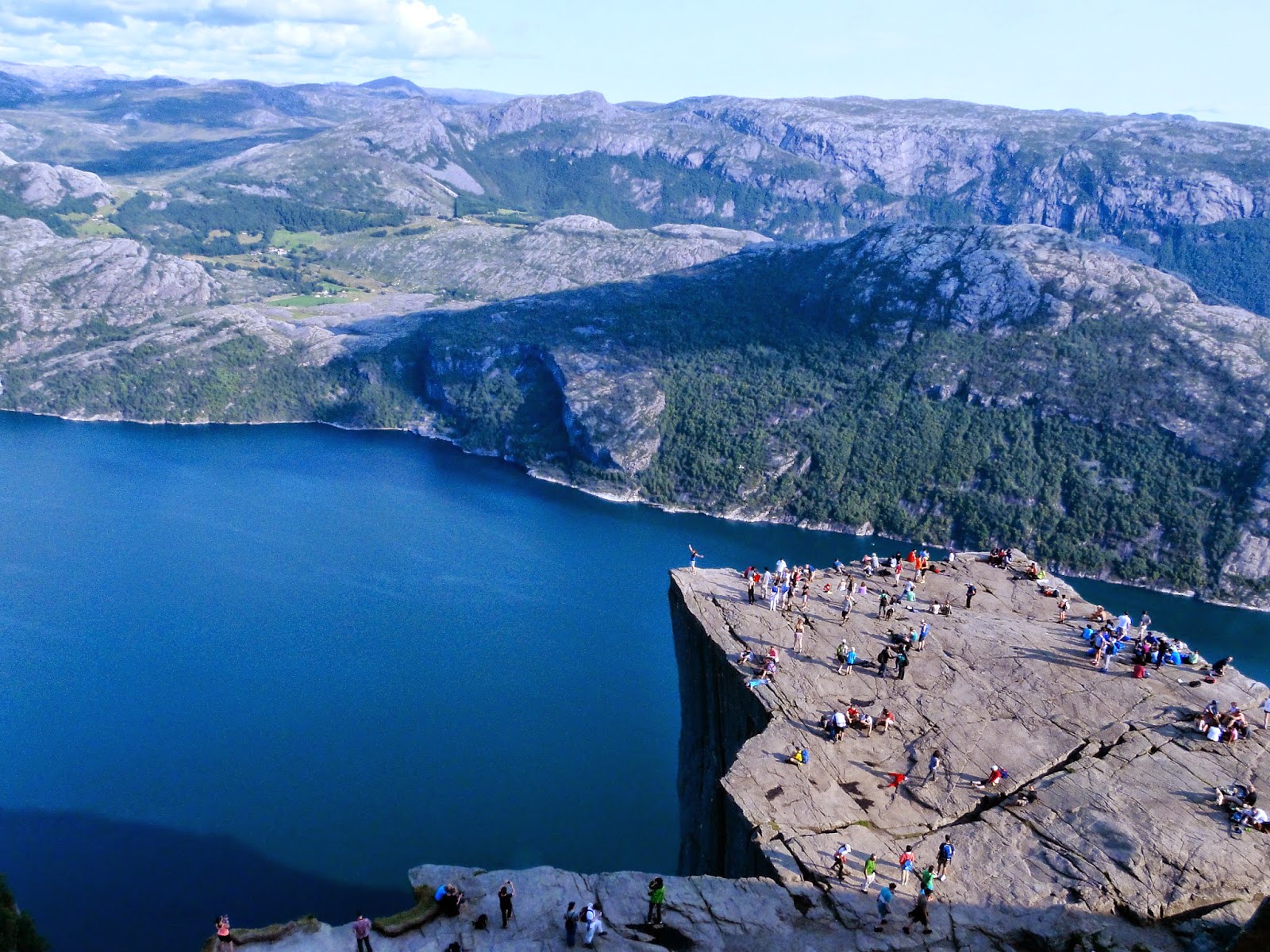
Tore was kind enough to send us out to Pulpit Rock for a fantastic hike overlooking the fjord,  and some of the Laerdal team joined us, including Sunny (Hopkins alumnus), Helge, Ida, Carolyn (Hopkins alumna), and Paulina. As I hiked up the large slabs of stone that comprised the steps along the mountain, Helge told me that it was actually sherpas from Nepal who had placed the stones and built the entire trail over the years. He said they had come to Norway for a few months each year to work--fitting that we learned this the day before we embarked for Nepal!

View in Stavanger on our way to the hike

Looking down from the first leg of the hike
 
Sign at the halfway point to Pulpit Rock
The trail up to Pulpit Rock was beautiful--Norway's bright blue skies above us and some nice clear weather to go along with them. It was also one of the busiest trails I have ever seen--Helge told me that every year, 250,000 people come out to the trail. I also got the chance to speak with Ida about her travels and past work, and can confirm that Laerdal really does have some of the best people working for them--it's quite the family and it was a privilege to get to know them.

Once we made it to Pulpit Rock, the view was breathtaking. Hundreds of people stood, sat, and ran around. Families, couples, even pets made the trek to look down over the fjord, and we gladly joined them, leaning back onto our nice blue backpacks (thank you Laerdal!) and eating our packed lunches. Some chose to look over the edge and pose for pictures leaning over or flying (Aaron), while others chose to sit back and enjoy the view. Some of us even went up above Pulpit Rock for an even better vantage point!

 View from most of the way up the trail looking down to the fjord
Pulpit Rock from above
Team Nepal on Pulpit Rock
On the way down, Aaron and I led the way and ended up hanging out with Sunny and some of our CBID classmates at the lodge. We got the chance to explore and sat down at a picnic table to take it all in. After a long hike, we were all content to relax and enjoy Norway--we couldn't have asked for better weather!

Swimming hole on the way back down
Nepal, here we come!
 
Sunrise in Delhi, India
After a great experience in Norway with Laerdal, it was time for us to leave--we got a preview of monsoon season when we woke up to pouring rain in Stavanger, and hopped on a bus to the airport at 5:45 AM. Even then, it still hadn't hit me that we were going to Nepal...

The Stavanger airport was just like the rest of Norway--everyone was kind and helpful, and above all, accommodation and efficiency were clearly their goal. Outside the gate, they had chairs and toys for children and even a screen for them to watch movies on, and provided an air hockey table and 3 foosball tables right next to the area for the older kids while they waited to board. Naturally, Aaron and I played some foosball, even at 6:30 in the morning (Aaron won, but it was still the best airport gate experience for me in a while).

Flying Air France was much the same, accommodating and comfortable. Although we only spent a couple of hours in the Paris airport, Allie managed to see the Eiffel Tower out the window. That counts, right?

Anyway, once we landed in Delhi, explored a little, and took a nap, it was suddenly time to board. We snapped a few pictures of the sunrise and boarded Jet Airways for Kathmandu (still hadn't hit me yet).

Once we finally arrived in Kathmandu, it hit me--we had made it to Nepal! A car from the Kathmandu Guest House was there to pick us up, and we were on our way to the hotel. With no lines to divide the street and cars and motorcycles everywhere, it was pretty impressive how our driver wove through traffic and got us to Thamel. It was strange for me to get used to driving on opposite side of the street too--Nepal driving really is either crazy or impressive, it just depends on your perspective. Once we had made it to the hotel, we met up with Aakash, a student interning with Jhpiego who will be working with us on our trip, and our group was ready to go.

The square in Thamel
Naturally, as soon as we were settled, we ventured out in search of lunch and exploration. After walking for fifteen minutes, a local art student started talking to us and showing us the temples and the marketplaces in the area. We were so overwhelmed by all of the sights we were taking in that we didn't think to realize that he was probably after getting some money out of us...but nonetheless his tour was very interesting and he gave us some good advice as well as a brief history of Nepal. After a while, he took us to his art studio and he and his friends showed us some of their work--which was amazing! Unfortunately, at that point they kept trying to sell us their art, and our guide finally relented and told us he would take us to a good place for momos, Nepali food which we were all excited to try. Earlier on, he had told us that he wouldn't take cash, but instead asked for us to buy him food for his family (Yes, again, we should have realized...), so at this point we stopped at a small storefront and he picked up some rice and flour and a few other items. Once this was rung up by the cashier to a total of what amounted to $70USD, we were astonished, but trapped.

Lesson learned: Guides on  the street aren't free


Luckily, he brought us to the momo place directly after and told us how to get back to Thamel, so we moved past our unfortunate first experience in Nepal and got ready to eat. Since each order of momos was only 60 Rupees (roughly 100 to 1 USD conversion), we assumed we would get one or two per order, so we each ordered 2 orders for ourselves. The first plate came with 10 momos, and so we thought that was our entire order and dug in--they were like dumplings but even better! Five or so minutes later, they brought out 9 more plates...each plate was one order, and each order was 9 momos. We had ordered 90!

Lesson learned: Find out how many momos there are in an order BEFORE ordering

After a brief return to the hotel to shower and get ready for our meeting, we took a cab to Jhpiego in Patan, a district within Kathmandu. We met Chandra Rai, the country director, Dr. Kusum Thapa, our main technical advisor and guide for the trip, as well as many others in the local Jhpiego staff, including Sheetal, Jona, and Sanjay. We were briefed about the logistics of our trip and the status of healthcare in Nepal, and we will be meeting again next week after our first week of immersion. We are excited to collaborate with them, and ready to get to work!
Delicious momos at the Small Star
P.S. Fun fact: Buff Fried Momos are water buffalo--now we know

Wednesday, August 6, 2014

Norway: Day 2 and 3

The team has spent the last two days at Laerdal Global Health in Stavanger, Norway interacting with Tore Laerdal himself and a number of his employees.This experience has been a wonderful immersion into the culture of the company in order to understand their mission, motivation and strategy for carrying out their goals in collaboration with organizations like Jhpiego and CBID. We've heard lots of presentations from employees who have had first hand field experiences in the field, toured the facility and been through a couple of interactive training sessions.

On Monday, the presentations were focused on learning about the history of Laerdal, the meaning of innovation and how they have been able to make an impact in the world by helping to save lives. Tore Laerdal spoke about the company's goal of "helping to save 500,000 people by 2015" and I must say; I was inspired by the passion and conviction with which he spoke! I also admired the level of specialization the company has, and its ability to pick and chose projects based on is core competencies yet adapt solutions to the need and country of implementation. Monica Thallinger a pediatrician spoke about her missions in Afghanistan, Somalia and 4 other countries and the challenges presented by each country. Rashmi talked about the success of certain training programs she has been able to implement in India with the support of the government, and Kidanto, a Tanzanian obstetrician discussed the need in Tanzania and the development of a new fetal heart monitor the Moyo. We learned about the success and recognition of "Helping Babies Breathe (HBB)" and the "Helping Mothers Survive (HMS)" training tools as well as how they were implemented.
The exciting part of the day involved touring the facility and playing with different training tools.
Aaron learning how to perform resuscitation on a baby. 
After a fun day at Laerdal, we were off to one of the best preserved medieval monasteries in Norway, Utstein Abbey, to learn about the history of Norway. 
 Allie enjoying the view outside Ustein Abbey
 Our wonderful tour guide Tor told us several historical stories about Norway that led to the formation of the monastery.After which we listened to beautiful songs in the chapel and ate at the oldest dining hall in Norway.
Tor our tour guide in the oldest dining hall in Norway

On Wednesday we continued to learn about the training tools developed by Laerdal, from a more technological standpoint. Tor Inge Garvik who leads project development explained the importance of being able to judge the success of a project early on in the development life-cycle. Next we got to see all the prototypes that were developed and learn how to use different tools. It often takes several iterations to come up with an efficient design!~ Don't be afraid to fail and don't get too emotionally attached to each prototype!
Patience holding the Neo Nathalie and trying out the new wrap used for kangaroo mother care 

The day ended with an interactive design training workshop with Paulina and Cansu. This session introduced us to some of techniques used by Laerdal to identify user needs and modify the design based on insight and user feedback.

Some of us had a picnic style dinner with Sunny Chen (a Hopkins alumnus) by the water side which was amazing!
Ian and the rest of the group at the picnic

General insights about Norway:
  • Everything is expensive
  • Stores close early (around 5pm)
  • The food is delicious; especially the fish (salmon, monk fish, etc) and bread!
  • Festivities are huge